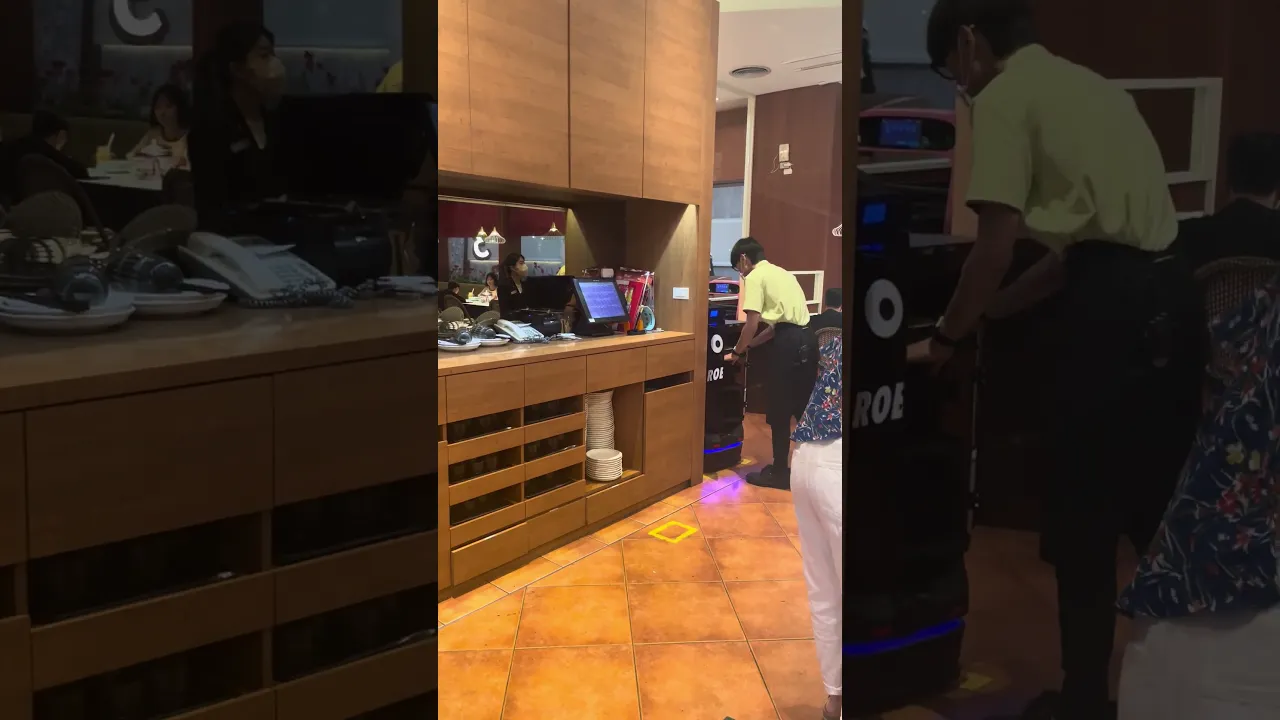

Restaurant Delivery Robot
My Roles
Service Researcher/ Product Designer
Service Researcher/ Product Designer
Company Info

Thai Town Company Limited
Thai Town Company Limited
Project Attribute
Service Design
Service Design
Service Design
Human-Robot Interaction
Timeline
2024/01 ~ 2024/05
2024/01 ~ 2024/05
Project Overview
Project Overview
Research Questions
Research Questions
Methodology
Methodology
Findings & Insights
Findings & Insights
Influence on Decision
Influence on Decision
Impact & Outcomes
Impact & Outcomes
Reflection
Reflection
OVERVIEW
As competition in the food service industry intensifies, restaurants need innovative approaches to improve service quality and operational efficiency.
This project focuses on introducing delivery and collection robots to reduce the burden of repetitive tasks such as delivering and clearing dishes from waitstaff, thereby freeing up manpower to engage more with customers.
The research will apply the "Job To Be Done" framework combined with an analysis of service touchpoints to comprehensively identify current workflows and interaction points, assess the impact of robotic assistance on process improvements, service efficiency, and customer satisfaction, and provide practical solutions for the restaurant industry.
As competition in the food service industry intensifies, restaurants need innovative approaches to improve service quality and operational efficiency.
This project focuses on introducing delivery and collection robots to reduce the burden of repetitive tasks such as delivering and clearing dishes from waitstaff, thereby freeing up manpower to engage more with customers.
The research will apply the "Job To Be Done" framework combined with an analysis of service touchpoints to comprehensively identify current workflows and interaction points, assess the impact of robotic assistance on process improvements, service efficiency, and customer satisfaction, and provide practical solutions for the restaurant industry.
RESEARCH QUESTION
What are the highly repetitive and labor-intensive tasks within the restaurant?
What are the main touchpoints between waitstaff and customers, and how do these affect service quality and customer experience?
How can delivery and collection robots reduce these repetitive tasks and simplify and improve service processes?
What technical limitations and challenges might robots face in the restaurant environment?
After introducing delivery and collection robots, how do the frequency and quality of interactions between waitstaff and customers change?
What are the highly repetitive and labor-intensive tasks within the restaurant?
What are the main touchpoints between waitstaff and customers, and how do these affect service quality and customer experience?
How can delivery and collection robots reduce these repetitive tasks and simplify and improve service processes?
What technical limitations and challenges might robots face in the restaurant environment?
After introducing delivery and collection robots, how do the frequency and quality of interactions between waitstaff and customers change?
METHODS
This study will collect data through field research, interviews, and on-site observations, using the "Job To Be Done" framework as the core approach.
By analyzing interaction factors within the service process, it will comprehensively map the touchpoints between waitstaff and customers, assess the impact of robot integration on existing workflows, and ultimately propose concrete optimization strategies to guide both headquarters and on-site staff.
Field Research & Insight Implement
This study will collect data through field research, interviews, and on-site observations, using the "Job To Be Done" framework as the core approach.
By analyzing interaction factors within the service process, it will comprehensively map the touchpoints between waitstaff and customers, assess the impact of robot integration on existing workflows, and ultimately propose concrete optimization strategies to guide both headquarters and on-site staff.
Field Research & Insight Implement
INSIGHTS SUMMARY


INFLUENCE ON DECISION
Reinforcing human warmth to balance the robot’s cold impression
After reviewing the study, we reconsidered the emotional impact of robots in the restaurant. Although robots are back-end tools, customers still notice them, which can cause confusion or feelings of alienation. To address this, we decided to add more human elements during implementation—maintaining proactive greetings and enthusiastic presentations by staff. For example, while delivery robots bring food to the table, servers personally introduce signature dishes like Kri Prince Fish and Meinan Jumping Fish. This interaction makes dining feel like a performance, attracting customers.
Customer perceptions matter even for B-end tools
Through implementation at Dajiang, Taimao, and Xizhi stores, we received valuable feedback. Tray-return robots face limitations in approaching tables closely, turning flexibility, and obstacle avoidance, occasionally colliding with staff or furniture. Some customers curiously block robots’ paths, but robots have automatic avoidance functions. Recognizing that robot operation affects customer experience, the district manager prioritized improving robot path stability and interaction cues to reduce disturbances.
Room for time-saving in robot-staff collaboration
Data shows robots reduce servers’ trips between kitchen and dining by about 30%, saving roughly one mile daily. This reduces physical strain and optimizes staffing. We and the district manager set a new goal to complete service within 15 seconds and avoid repeated staff entries into the same area, making cooperation more strategic. Detour routes for meal pick-up were also reviewed to enhance efficiency and experience.
Overall, the research and fieldwork clarified bottlenecks and confirmed the potential of robots and smart systems to improve service efficiency. We will continue focusing on user experience and on-site needs to drive ongoing optimization.
Reinforcing human warmth to balance the robot’s cold impression
After reviewing the study, we reconsidered the emotional impact of robots in the restaurant. Although robots are back-end tools, customers still notice them, which can cause confusion or feelings of alienation. To address this, we decided to add more human elements during implementation—maintaining proactive greetings and enthusiastic presentations by staff. For example, while delivery robots bring food to the table, servers personally introduce signature dishes like Kri Prince Fish and Meinan Jumping Fish. This interaction makes dining feel like a performance, attracting customers.
Customer perceptions matter even for B-end tools
Through implementation at Dajiang, Taimao, and Xizhi stores, we received valuable feedback. Tray-return robots face limitations in approaching tables closely, turning flexibility, and obstacle avoidance, occasionally colliding with staff or furniture. Some customers curiously block robots’ paths, but robots have automatic avoidance functions. Recognizing that robot operation affects customer experience, the district manager prioritized improving robot path stability and interaction cues to reduce disturbances.
Room for time-saving in robot-staff collaboration
Data shows robots reduce servers’ trips between kitchen and dining by about 30%, saving roughly one mile daily. This reduces physical strain and optimizes staffing. We and the district manager set a new goal to complete service within 15 seconds and avoid repeated staff entries into the same area, making cooperation more strategic. Detour routes for meal pick-up were also reviewed to enhance efficiency and experience.
Overall, the research and fieldwork clarified bottlenecks and confirmed the potential of robots and smart systems to improve service efficiency. We will continue focusing on user experience and on-site needs to drive ongoing optimization.
IMPACT & OUTCOMES
At the conclusion of this study, the larger-sized Dajiang, Taimao, and Xizhi stores were ultimately selected for the field implementation of both food delivery and tray-return robots.
These locations feature spacious aisleways (approximately 1.5 meters wide or more), providing a suitable environment for robot operation. With robotic assistance, the number of daily trips servers made between the kitchen and dining area was reduced by about 30%, effectively saving roughly a mile’s worth of walking distance.
This not only eased the physical workload of service staff but also enabled the restaurant to attract a more diverse range of individuals to frontline roles, thereby improving working conditions and the overall labor environment.
Notably, the study also found that customers were curious and delighted by the presence of robots in the dining experience. As a result, particular care was given to the design and hygiene of the robots, enhancing both the atmosphere and perceived quality of service.
At the conclusion of this study, the larger-sized Dajiang, Taimao, and Xizhi stores were ultimately selected for the field implementation of both food delivery and tray-return robots.
These locations feature spacious aisleways (approximately 1.5 meters wide or more), providing a suitable environment for robot operation. With robotic assistance, the number of daily trips servers made between the kitchen and dining area was reduced by about 30%, effectively saving roughly a mile’s worth of walking distance.
This not only eased the physical workload of service staff but also enabled the restaurant to attract a more diverse range of individuals to frontline roles, thereby improving working conditions and the overall labor environment.
Notably, the study also found that customers were curious and delighted by the presence of robots in the dining experience. As a result, particular care was given to the design and hygiene of the robots, enhancing both the atmosphere and perceived quality of service.
Reflection
Implementing robots on-site gave us a real sense of the complexity and details involved. Thanks to the district manager with 17 years of experience and the executive assistant from the GM’s office, we caught many issues that only come up when you’re actually there.
The robots still have limits in obstacle avoidance, route planning, and flexibility, showing us that the technology needs ongoing improvement to better fit real conditions. We also have to consider table turnover, number of tables, space efficiency, and robot paths to keep operations smooth.
Customers’ reactions surprised us—some even block the robot out of curiosity—highlighting the need for better interaction design to avoid disrupting the dining experience.
From the data and feedback, it’s clear that robot-human collaboration isn’t about replacing people, but about fine-tuning workflows and roles to balance efficiency with quality service.
Implementing robots on-site gave us a real sense of the complexity and details involved. Thanks to the district manager with 17 years of experience and the executive assistant from the GM’s office, we caught many issues that only come up when you’re actually there.
The robots still have limits in obstacle avoidance, route planning, and flexibility, showing us that the technology needs ongoing improvement to better fit real conditions. We also have to consider table turnover, number of tables, space efficiency, and robot paths to keep operations smooth.
Customers’ reactions surprised us—some even block the robot out of curiosity—highlighting the need for better interaction design to avoid disrupting the dining experience.
From the data and feedback, it’s clear that robot-human collaboration isn’t about replacing people, but about fine-tuning workflows and roles to balance efficiency with quality service.


Outline